03 June 2006

The other Vancouver

We spent the holiday weekend in B.C. with Mom and Dad. Despite the two-hour wait at the border to get into Canada, the trip went smoothly.

Highlights include a fabulous Indian dinner at Vij's, a fun bike ride around Stanley Park, a lot of wine and a quick lunch in a Chinatown diner. We did lots of walking. While at the Granville Island Market, Mom got the idea of having a picnic, so we bought some smoked salmon, gorganzola cheese, olives and dolmas. Made for a nice lunch in the park.

While the food at Vij's was just as great as last time, there was another part of that experience that my mom and I will be talking about for a while. As we sat in the bar waiting for our table and drinking our first bottle of wine, I kept looking at a familiar-looking guy at the next table. Then, I finally realized I knew him from TV. I asked my mom if he looked familiar. Then, just as the hostess came to get us for our table, we realized who he was: Charlie (Dule Hill) from "The West Wing"! IMDB will have to do, we didn't go all paparazzi or anything.

We did have our camera at other points, though. Here are some pictures:

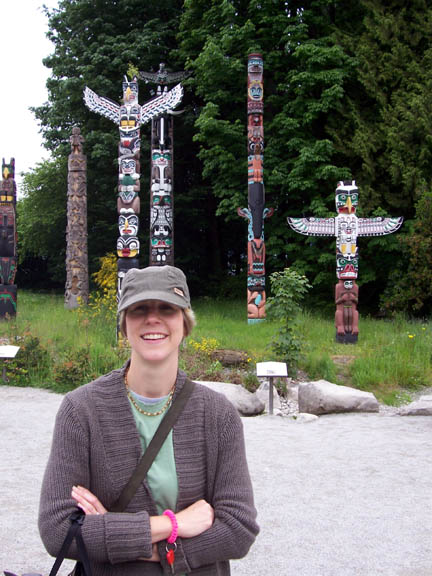
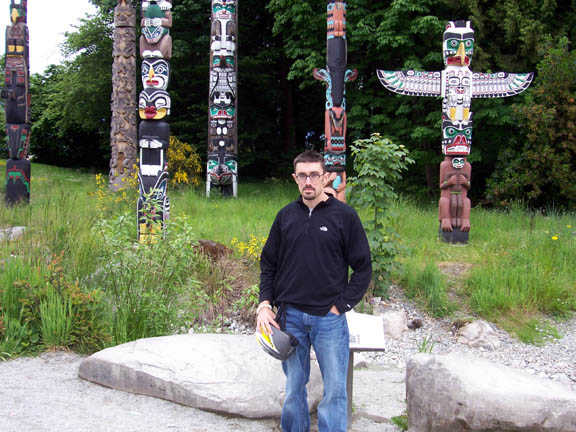
Seth at the totem poles in Stanley Park.

Totem poles.

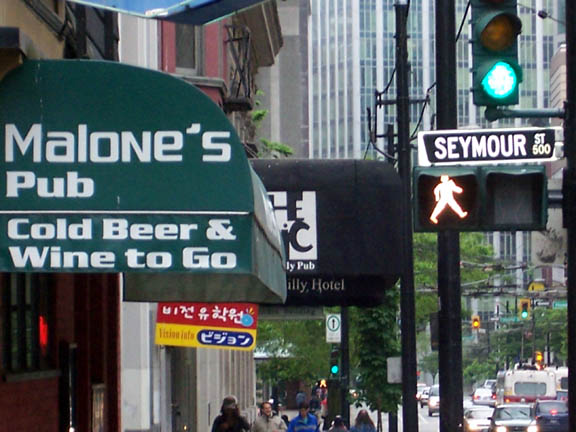
We call this The Strut. Amy loves the eager "walk" signs in B.C.


More from Stanley Park.

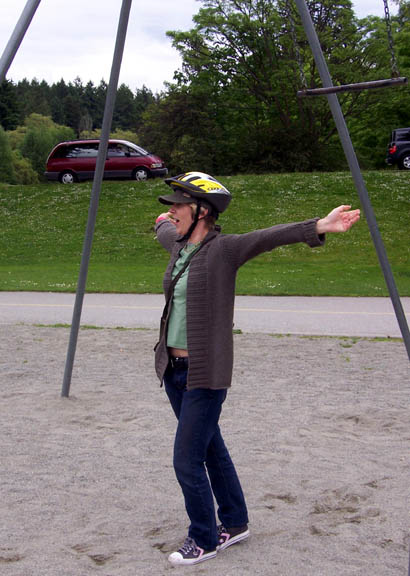
Amy channels her inner fellow Oklahoman, Shannon Miller, by performing a flawless dismount from playground equipment in Stanley Park. Gotta love the bicycle helmet.
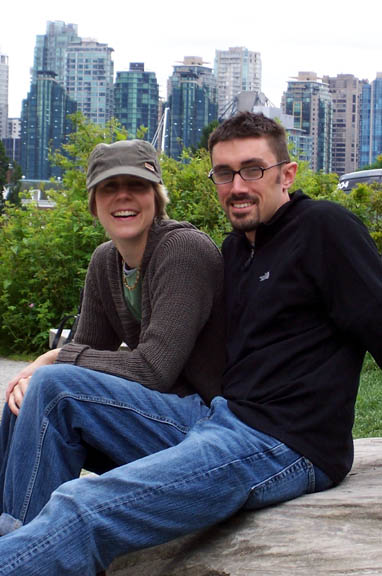
Us in Stanley Park.

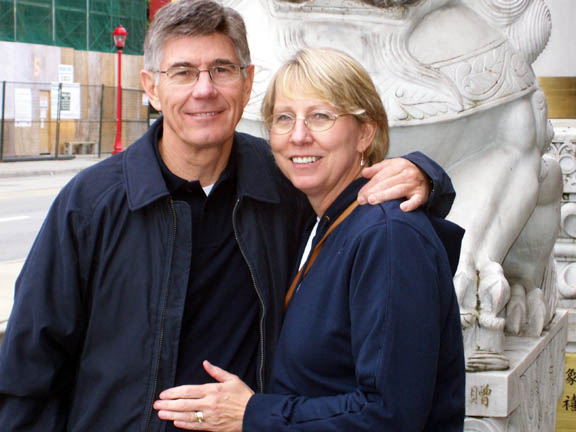
Tim and Linda in Chinatown.

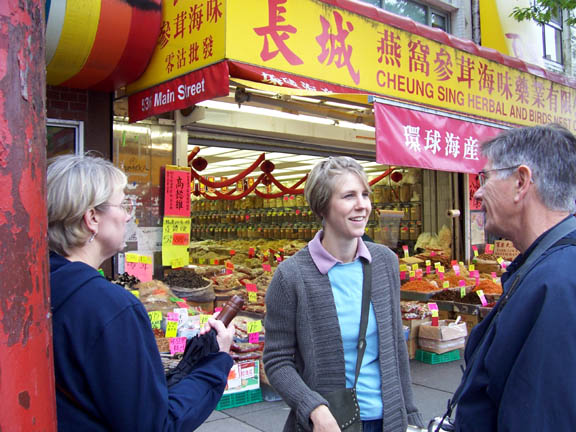
Amy takes charge of lunch plans. Tim and Linda are probably thinking, "Where are they taking us to eat now?!"

If you don't know who or where this is by now, too bad.

Downtown from Granville Island.

24 May 2006

On the road again...

Up next: Back to B.C. Taking Amy's parents up during their upcoming visit. And any trip to the other Vancouver means a chance to revisit Vij's restaurant. I'm hungry just thinking about it. Mmmm.

It'll be great to get back north of the border for a while. Amy and I really enjoyed our trip there last fall, so we're looking forward to sharing what we've seen of the city and exploring new parts, too.

We'll post some words and pictures upon returning.

22 May 2006

Neighborhood kickball

Game Two of the Hough Neighborhood World Series of Kickball was held Sunday. It's such fun the group has decided to play every other week rather than just once a month.

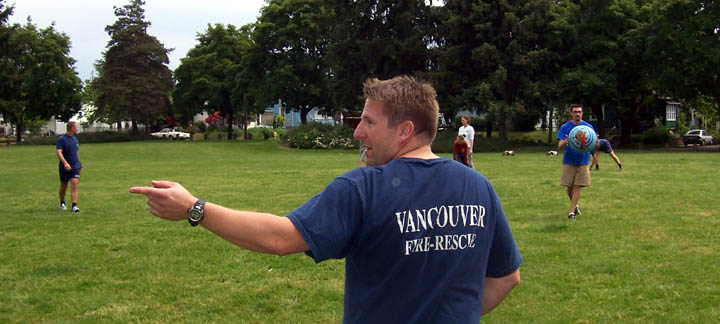
This time, our friend Eric brought his colleagues at the fire department to join us for a few innings between calls. They had to leave on a call at one point, but came back afterward to play some more. Here they are shedding the coveralls in the outfield after stepping off the truck.


And, as predicted recently in this space, I went yard. That's right, home run. To right center. The firemen would have needed the ladder truck to get high enough to catch that baby! OK, maybe it just barely cleared the guy's head, but I still touched 'em all. Sadly, this grand moment in kickball history will only live on in memories and steadily embellished re-tellings for future generations. Amy was helping chase down the ball rather than taking a picture.


Here the giant blue Scooby Doo ball momentarily becomes stuck on the head of the woman playing first base. Neither Scoob or Jackie were injured. Play quickly resumed.


One of the firemen, realizing I'm bringing the heat from the mound, asks someone else to please take his place at bat. Or maybe he was just being polite and asking one of the women if they'd like to go. Nah, I'm pretty sure it was about my intimidating presence.

Steve, our neighborhood co-president, is one helluva switch kicker. Possibly the only such ambidextrious player in existence. Here, kicking right-footed, he gets air down the left-field line.

And here, kicking left-footed, he goes deep to right. Look at that follow through!

19 May 2006

The backyard project

We're making a lot of headway overhauling the backyard from the landfill it doubled as for the previous owners to a relaxing space we'll enjoy hanging out in this summer and beyond.

We don't have any digital pictures of what it was like when we moved in, but it was bad. Really, everything about the place was bad on the surface. But that was the beauty of it. It was ours to save.

In the back pasture, as we called the itty-bitty space, you couldn't put a foot down without stepping in dog crap. Beyond that, there was trash everywhere, particularly broken glass. Weeds had overrun the lawn, and what landscaping there was had overtaken its spaces.

There was a medium-size, well-worn, partially rotted deck. It was covered in grease stains from a couple of grills. And the entire structure was topped with a flimsy plastic sheeting that had moss growing on the top side, leaving it really grungy looking.

Luckily, a month after moving in a massive ice storm hit. Someone built a particularly top-heavy snow ho at a bus stop down the street. Much like that creation, some of the uglier bushes buckled under the weight. With that, we were on the path to demolition. I have to say, I'm good -- really good -- at the demolition side of things.

Fast forward through lots of litter pickup, landscaping and stump removal, lawn rehab and repair, and digging out a couple hundred square feet of new flowerbeds. Then we sat back and said, "OK, what next?"

That big old deck hulked over the space, making it feel smaller than it was. Amy, the vision part of our home-remodeling team, said, "What if we tore down the deck, blew out the driveway, extended the yard and built a new fence?" Sure, it'd be a lot of work, but it'd solve our needs:

1. Make the space feel bigger with that deck/covering out of the way.
2. Add about 200 square feet to the yard by taking out a section of the driveway. The circa 1907 garage is really too small to park a car in anyway.
3. Define the larger new space with a fence that was actually secure and nice looking.

So we started. First, we got the property surveyed, the driveway jackhammered out and a fence put in. Then I tore down the deck -- again, I love doing demo work. Me and a crowbar make for a happy afternoon.

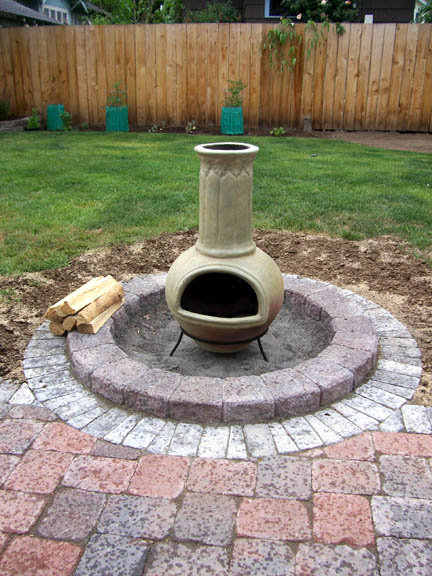
We started sketching out what we wanted instead of the old deck. Because the house doesn't have a fireplace, I really wanted some area in the new backyard where I could enjoy a small fire. Finally, we came up with plans for a roughly 10'x22' patio area, with a 5' diameter fire pit extending from the leading edge. We'd run parking strips through the old driveway area to meet city code. And we'd get started, finally, on the herb and vegetable garden we'd been waiting to put in.

So we called in help where needed and did the initial excavation.

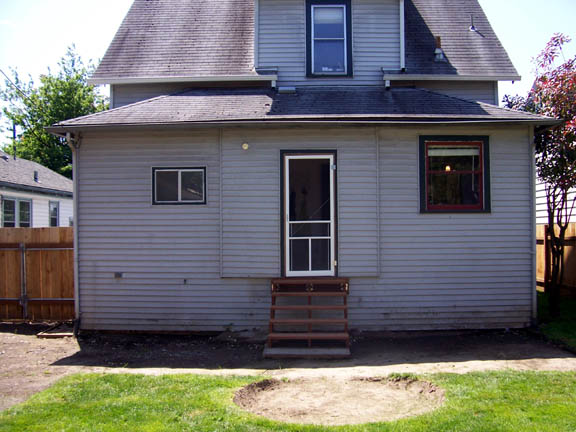
That left us with this in April. It was a swamp when it rained. Got a patio contractor lined up, hashed out the nitty-gritty on the specifcs of the plan. Waited.


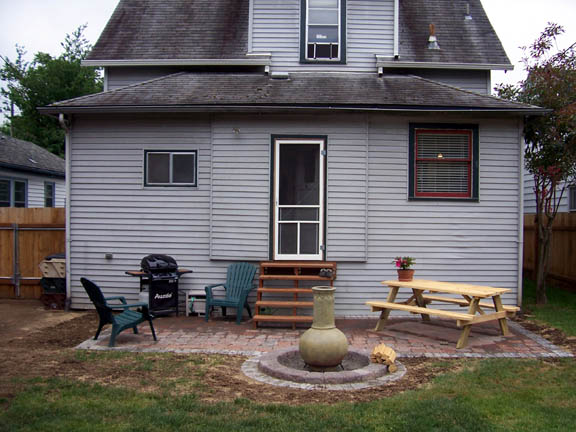
And now the patio is in. Put a little chimenea in the fire pit. Got a new picnic table. Wheeled the trusty grill back out of the garage. Cracked open a couple of beers and started up a fire.


Of course, the first two nights we burned fires were the two hottest days of the year so far. And there's still some more leveling work and cleanup to do. But we don't care, we'll get those wrapped up soon. We love it. That's the garden in the background. We've got rosemary, lavender, strawberries, sage, thyme, mint, tomatoes, squash, cabbage and some other stuff.

Now if we can just get that grass seed to take hold.

C'mon over. We'll throw another burger on the grill, another log on the fire and another beer or two on ice.

08 May 2006

Kickball

Kicks my ass.

We played in the inaugural take-back-our-park game two Sundays ago. It was a bunch of 20- and 30-somethings, generally, playing kickball in a sketchy park on the west side of our neighborhood. Then we all go to a bar and have a drink.

Much fun. Much pain. That or I'm just getting old and discovering there's a reason I never played soccer. Apparently rather than kicking with my foot, I managed to use my shin bone as a baseball bat. I'm bruised. I'm whiny. I'm lame.

And next time, I'm kicking right and going yard.

28 April 2006

South Dakota

We got back from Mexico late on a Sunday night and I was back at the airport early the next Tuesday for a trip to South Dakota for a journalism conference.

A couple of pictures:


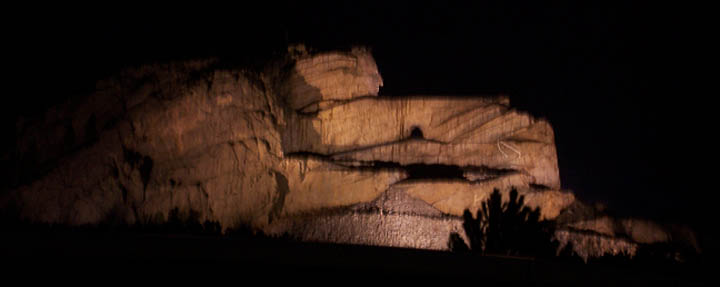
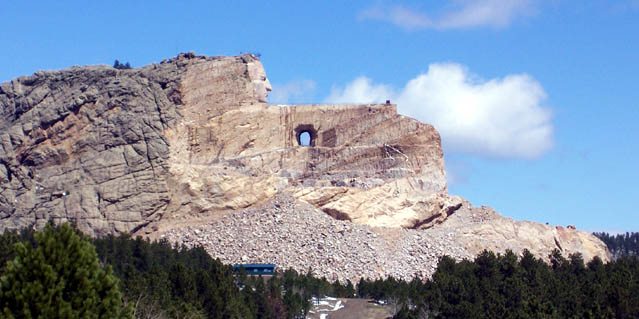
Crazy Horse Monument, where a bunch of journalists gather for three days every April to work with Native high school kids, to show them what's possible and why it matters.

A scale model of what the mountain will look like when it's finished.


There's a wonderful saying at Crazy Horse, which captures the essence of the work on the mountain and the work with the students: "When the legends die, the dreams end. And when the dreams end, there is no more greatness."


Mount Rushmore is just down the road from Crazy Horse, also in the Lakota's sacred Black Hills. Construction of Rushmore prompted Chief Henry Standing Bear to ask Korczak Ziolkowski to come to the Black Hills and build a monument that honored Natives.
"My fellow chiefs and I," he said in 1939, "would like the white man to know that the red man has great heroes, too."

27 April 2006

Mexico Journal: Good Friday, Part II

More pictures from the Procession of Silence in Oaxaca:


26 April 2006

Mexico Journal: Good Friday, Part 1

We've already written a lot about Oaxaca and our journal entries from April 14. Those parts were special for sure, but what made it a day unlike any other was the fact that it was Good Friday.

Now, bear in mind we're not the most church-going of kids. Much less Catholic. Living in big-time blue state country, outside a city once known as Little Beirut because of the regular ruckus that unfolded with Republican administrations visited Portland.

So the fact that we happened to schedule our trip during La Semana Santa, or Holy Week, was a happy accident. This trip was supposed to be about getting off the typical gimme-gimme-gimme tourist path and instead seeing -- and, we hoped, experiencing -- real parts of Mexican culture.

On the day we got into Oaxaca, we met a very nice woman at our hotel who spoke English. We asked her if there would be any special religious events going on as part of La Semana Santa that it would be OK to check out while we were in town.

Immediately she said, Yes, Friday night. 6 o'clock. On Alcala Street. A big parade. Masks. Crowds. Perfectly fine for you all to go and observe.

Great, we thought. That'll be a perfect way to wrap up our last night in town.

Friday morning we get up and leave for the day-long tour to Monte Alban, the Dominican monastery, the wood carvers and the pottery. We were supposed to be back in town about 6 p.m. This is where Mr. What-Time-Is-It? wastes an hour of my life sitting on a mountaintop outside town. And this is why I was all the more irritated with the guy. The woman at the hotel had told us the night's festivities would start about 6.

So finally the van gets back to town close to 7. Drops us at our hotel about 7:15. We run upstairs, ditch our bags, grab some water and start walking toward Alcala, which is a few blocks north and east of the zocalo. It's a pedestrian street running north through town and in front of Santo Domingo Cathedral.

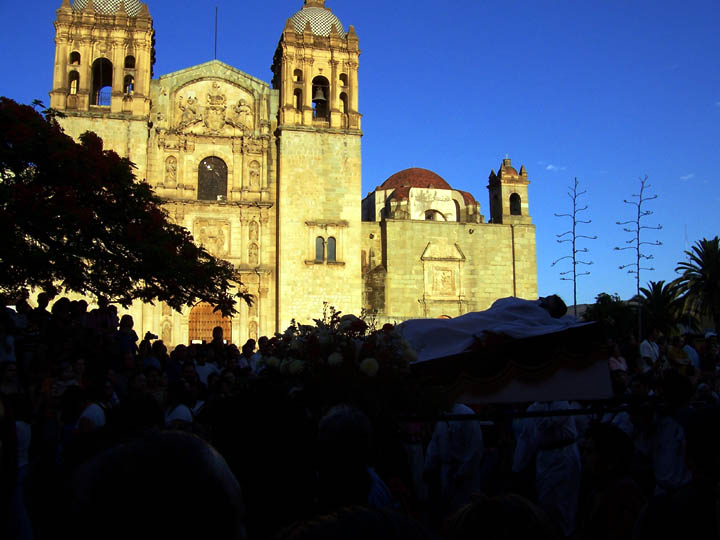
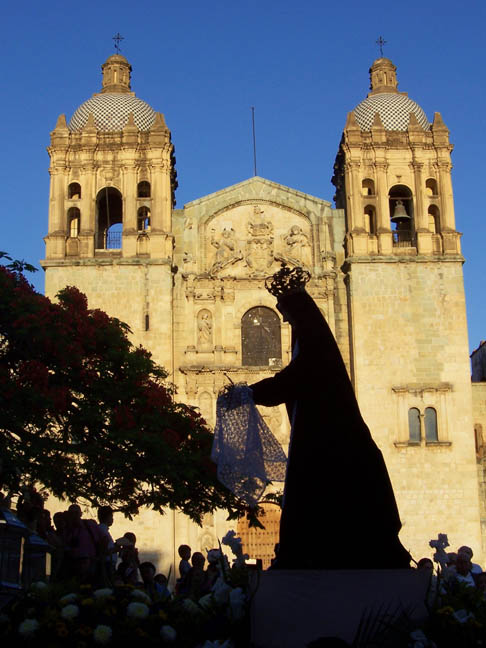
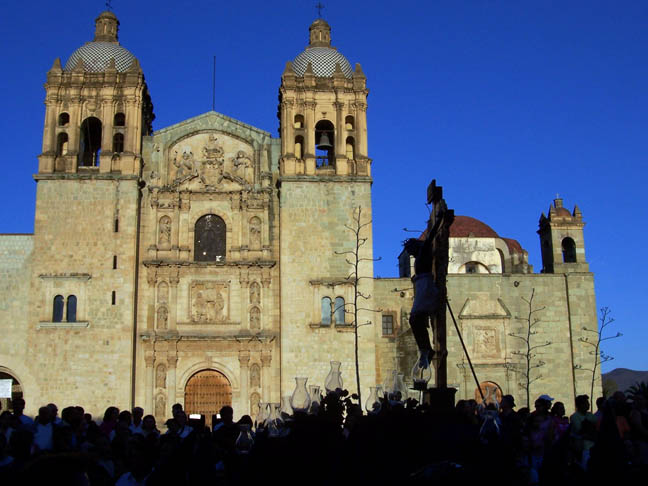
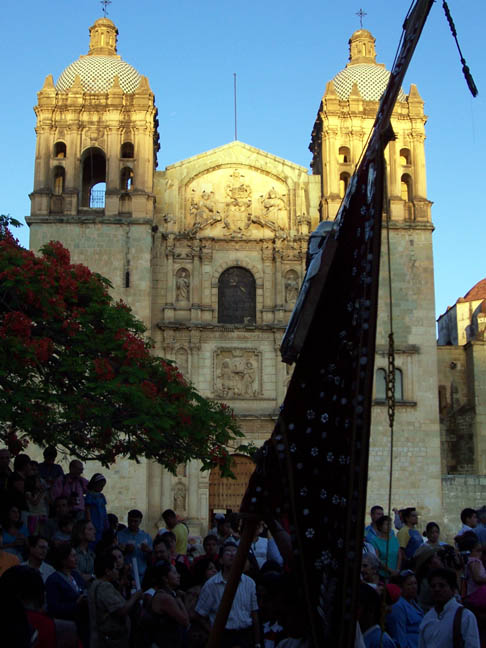
Santo Domingo, which Aldous Huxley called "one of the most extravagantly gorgeous churches in the world." For all its exterior beauty, it's even more striking inside.

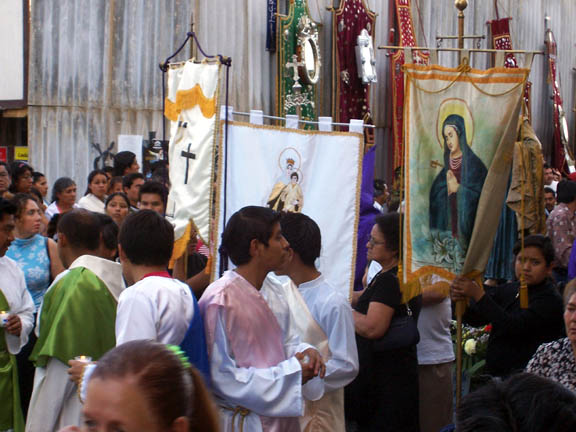
As we start making our way up Alcala, the usual crowds are out milling around, but they're thicker than the previous nights and there's all these banner-like things either leaning against buildings or being held by people, mostly kids.


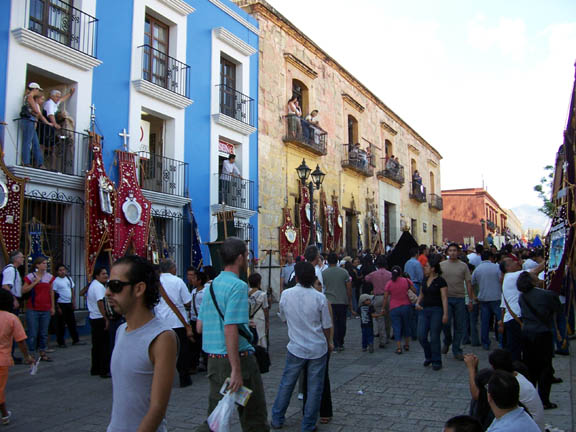
The scene as we head up Alcala Street.

We keep trucking it north until we get to the throng. We're close to Sangre de Cristo Church at the corner of Bravo and Alcala. There are thousands of people. It's so crowded that it is hard to move. We start looking around to see if it's OK to be here. But the local TV station is there filming from the middle of the street, lots of people have cameras and camcorders out, and we are far from the only white-looking faces in the crowd.


The waiting.

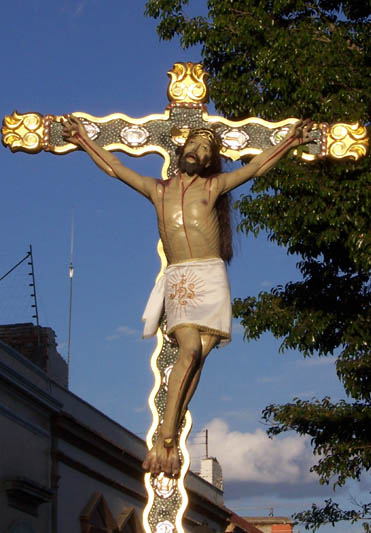
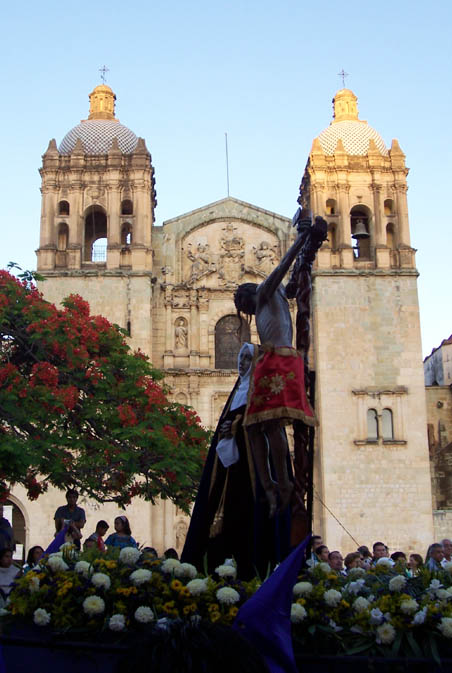
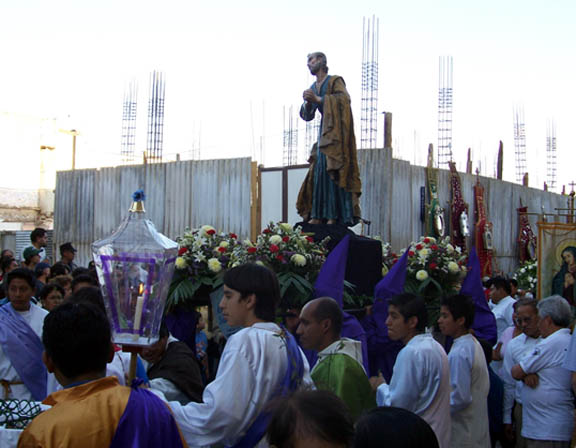
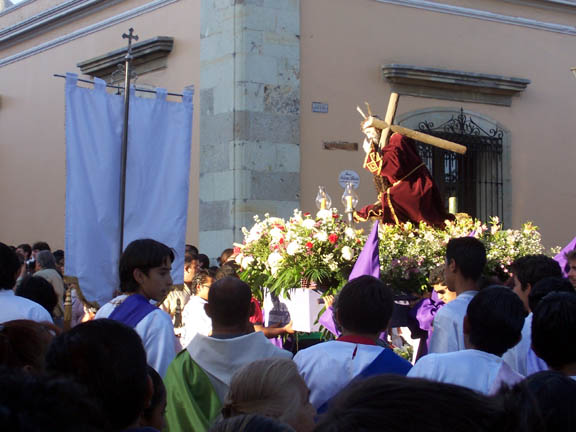
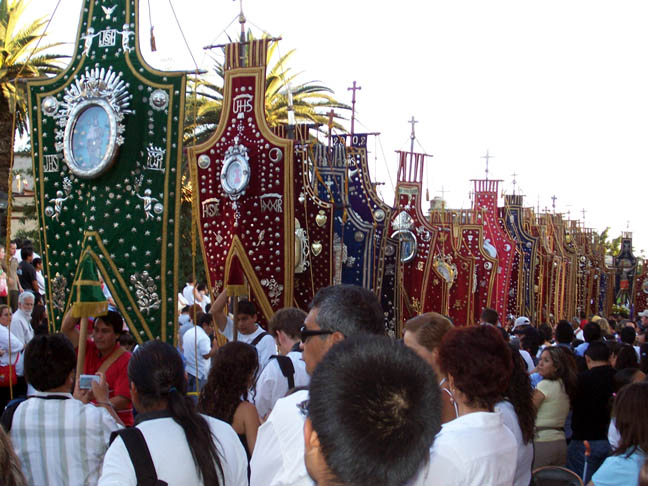
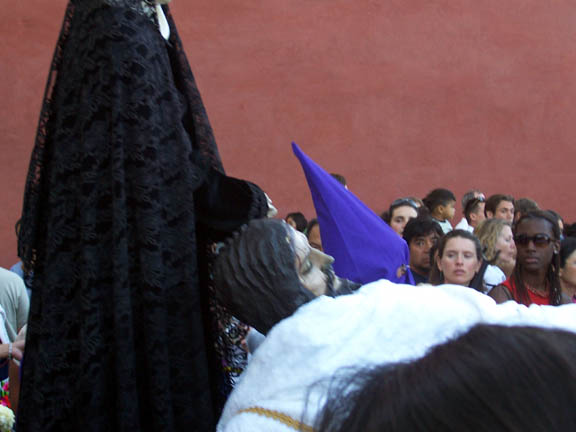
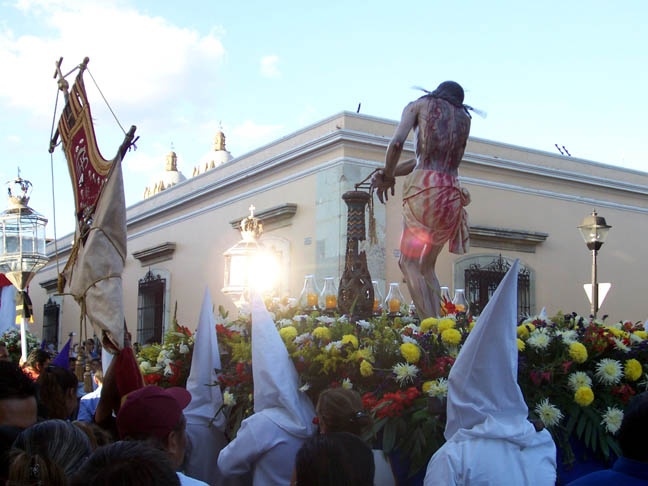
The event, which is called the Procession of Silence, is a re-enactment of the crucifixtion, complete with flags and icons from churches throughout town. The flags seem to be made from a thick velvet, often in deep reds and rich greens. The icons, on flower-covered bases like a parade float, are extremely graphic -- blood, hair, thorns, bruising, bones. And there are people all over the street dressed in white and purple. Some with pointed hoods.


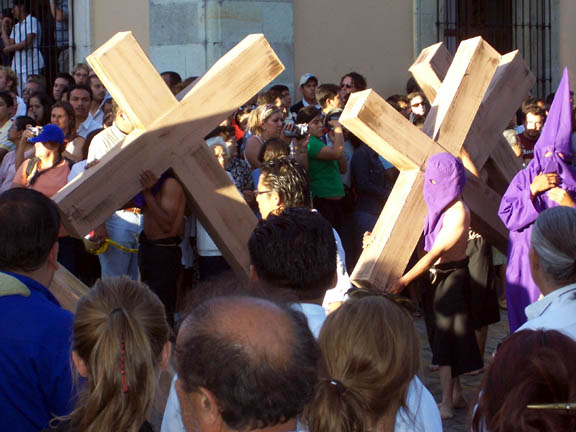
Onlookers outside Sangre de Cristo wait for a float bearing two icons to be raised.


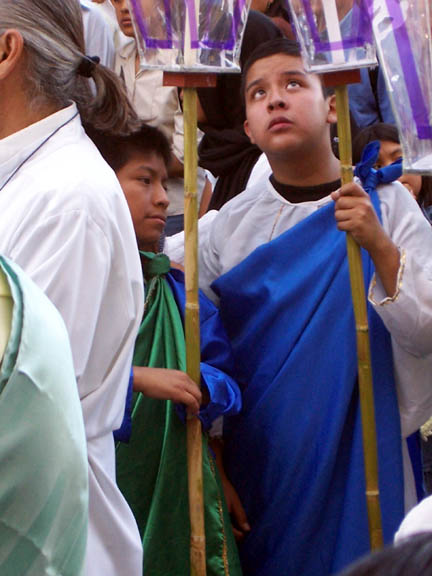
Boys taking part in the procession wait for proceedings to begin.

A man with a microphone at Sangre de Cristo Church is reading something, passionately, in Spanish. We understand only bits and pieces. All goes quiet again after he finishes. Then drumming starts, keeping a slow but steady beat. The participants hoist the icons onto their shoulders. The march begins. All as the sun slides away, shimmering across the entire scene.


Hoisted onto shoulders, flashed into memories.

25 April 2006

More pictures from Oaxaca


The scene outside our hotel's front door, with the market across the street. Yep, it's really in Oaxaca, even though that awning says Veracruz.


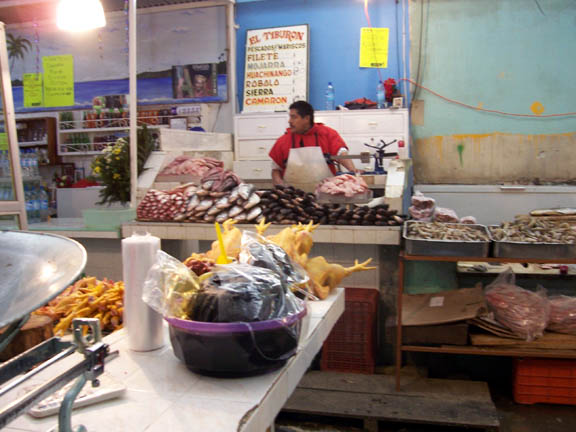
Another meat vendor in the market. Chickens, fish, beef. Whatever you want, they've probably got it.


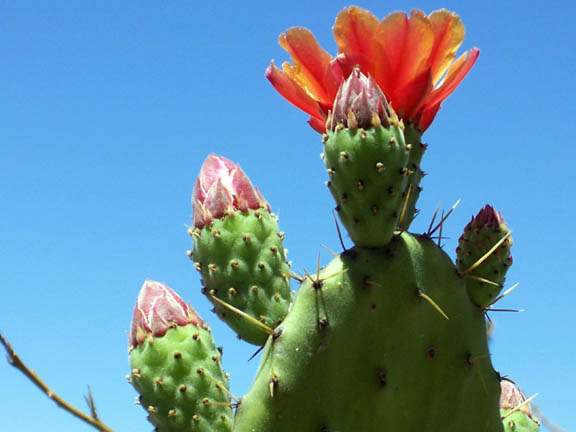
A cactus in bloom at Monte Alban.


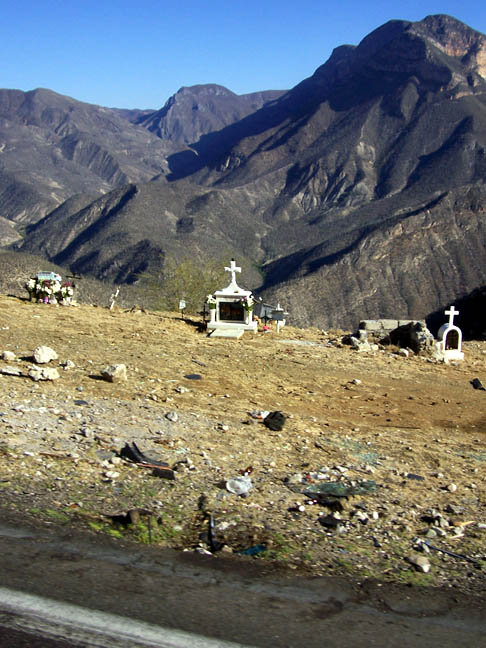
Roadside shrines on the outskirts of Oaxaca.


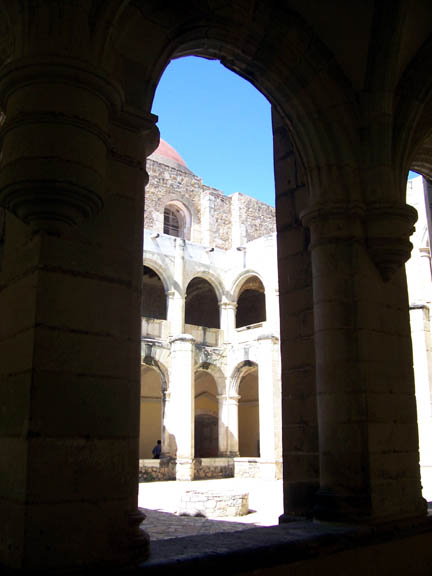
Inside the monastery's courtyard.

Mexico Journal: 14 Abril 06, cont.

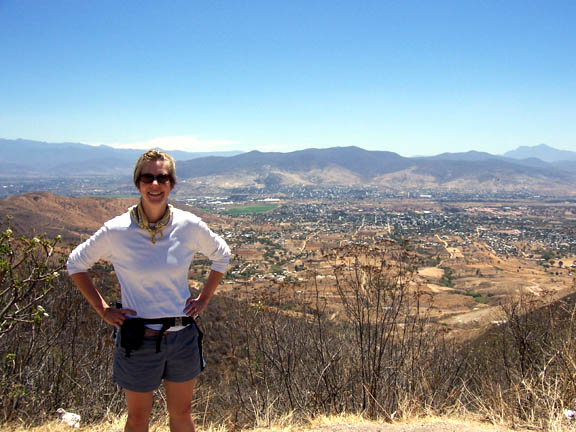
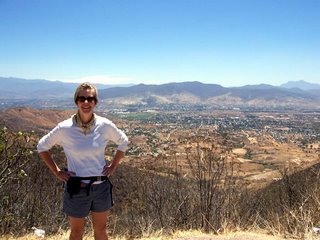
Amy at Monte Alban, with Oaxaca in the background.
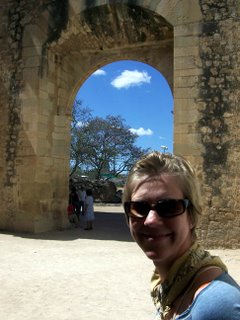

Amy at the Dominican monastery outside Oaxaca.
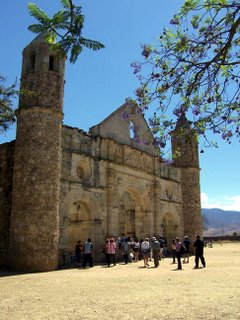
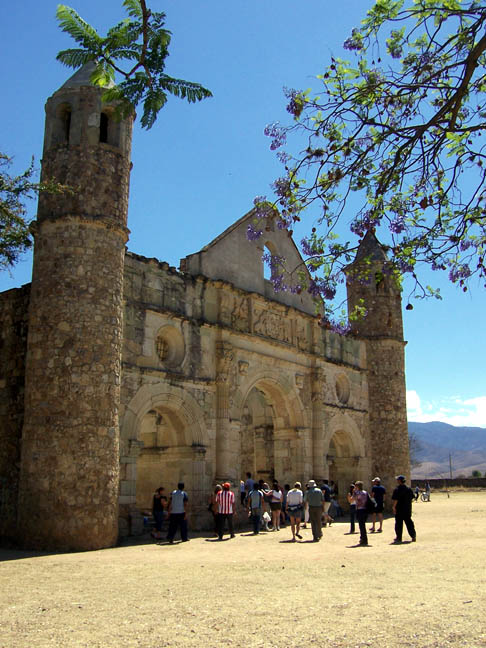
The monastery itself.

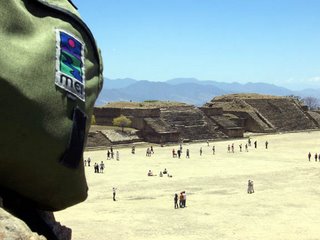
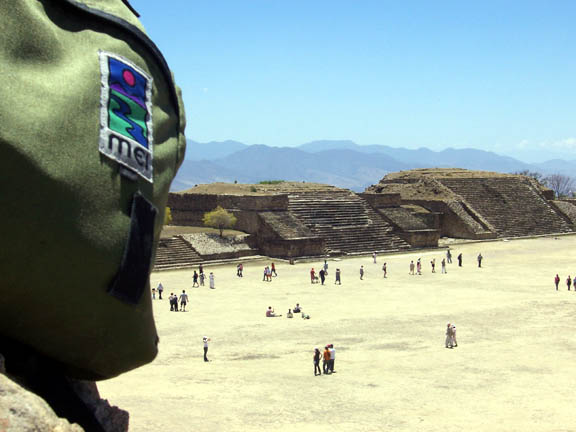
Mike's bag surveys the grand plaza at Monte Alban.
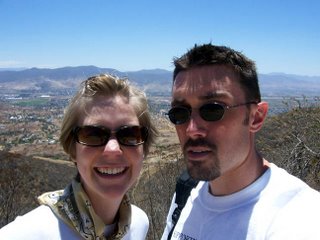
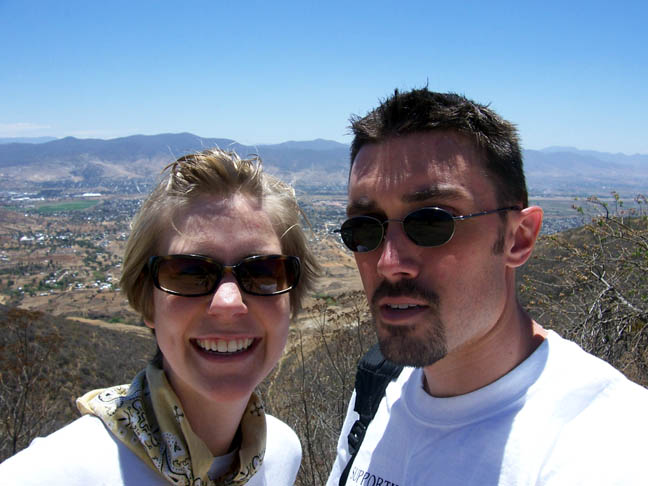
On top of the mountain.

Seth wrote:

The end of our stay in Oaxaca is drawing near and we'll be sad to leave this very special city. I'm already looking forward to returning someday (Dia de los Muertos '07?).

The people here are very different from those in the other cities we've visited. I think, perhaps, that's a reflection of the indigenous Zapotec influence. Maybe I'm all wrong, though. People are very kind and helpful, but much more reserved and introverted than the people in Veracruz, for sure, and even in Puebla, to some extent.

You see many more darker-skinned people here. A couple we met on today's tour (more on that later) talked about the class system that dominates Mexico. They said wealth trumps race, but wealth in many ways is predicated on race. From how they -- he was an Indiana transplant to Mexico City who married a woman from Monterrey -- described it, people are all but locked into the societal level in which they are born.

That's hard to think about when on opposite ends of one block you see the following: A very old indigenous woman sitting and begging for change all day on one corner. Then, on the other, an indigenous boy of no more than 5 playing an accordion with his little brother in tow, singing in the deepest voice he can possibly muster (think of a young Tom Waits) to make money. We saw that kid all over town. Next time we come back, will they still be there, eeking out an existence?

The poverty is everywhere and striking. But so seems to be a happiness, a certain take-life-as-it-comes spirit, that maybe manages to counterbalance things. Or maybe I just want to see it as such. I don't know.

The city sits in a sweeping valley and is surrounded by grand, towering mountains. There's none of the smog we saw in Mexico City. The vivid blue skies are ever-present. And with so many fewer lights than in U.S. cities, looking out or hotel window tonight in the middle of downtown just a block off the zocalo, I could see stars all across the sky.

Today's tour was the one tourist-esque thing we've really done all week. We saw: Monte Alban, massive Zapotec ruins; the remains of a grand, old Dominican monestary; the maker of alebrijes, intricate animal-shaped wood-carvings; and tons of Oaxaca black pottery.

Monte Alban was stunning. To think that the Zapotecs cleared and leveled the mountaintop by hand; hauled stones into place to build altars, palaces, ball courts, even a water filtration and delivery system is just shocking. And we can't seem to fix Baghdad, much less New Orleans?

We were on a schedule during this day-long tour. It was the first time all week that we'd had to pay any real attention to a clock, much less have our schedule influence anyone or vice versa. So when the tour guide at the ruins said to be back at the van at 1 p.m., we were there on the dot. An hour later a couple and their infant strolled up to the van, where about a dozen people had been waiting for them.

No "Lo siento." No "sorry" any language, in fact. So when the guy actually turned to me and asked, "What time is it?," I didn't want to say, "2 o'clock." I wanted to beat him with the kid's stroller while yelling, "It's an hour after you were supposed to be here and we've all been sitting in this hot van in a dusty parking lot waiting for you."

There's an hour of my life I'll never get back. So, of course, being the logical guy I am, I spent the next hour or so of the tour fuming.

The alebrijes were cool, but I was still pissed when we got there.

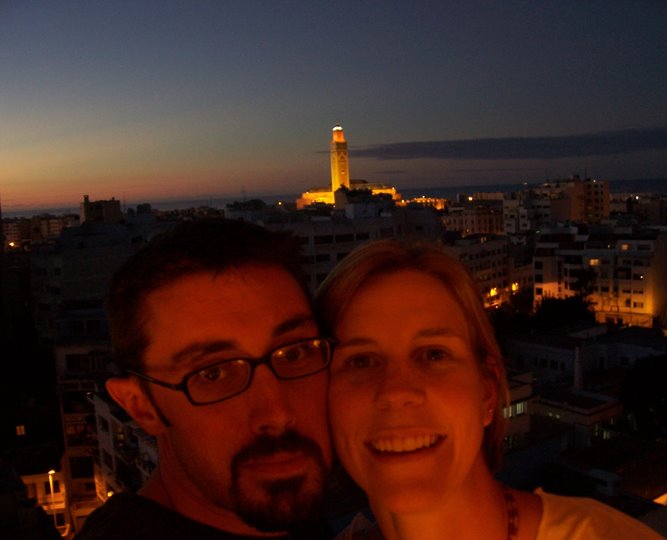
The monastery had a lot of Spanish influences, of course, and I think we'll see some of those more Moorish elements this fall when we visit Morocco.

The black pottery is one of those things that immediately says Oaxaca. We got some great pieces to go with one Amy brought back from her trip in 2000.

Lunch, when the tour finally stopped for it, came at 6 p.m. Perhaps that, and the hour wasted in the parking lot at Monte Alban, was part of living on what one fellow traveler called the Latin schedule. Even with that pain, it couldn't derail another great day.

Mexico Journal: 14 Abril 06

Amy wrote:

The report after two full days in Oaxaca: The first we spent in markets and visiting El Arbol de Tule. Despite the laughter from our friends when we told them we were visiting a giant tree, it was great. They're jealous, we know.


The famed Tule. Called the oldest tree in North America. Like many Americans, it's wider than it is tall. This shot shows about one-quarter of its diameter.


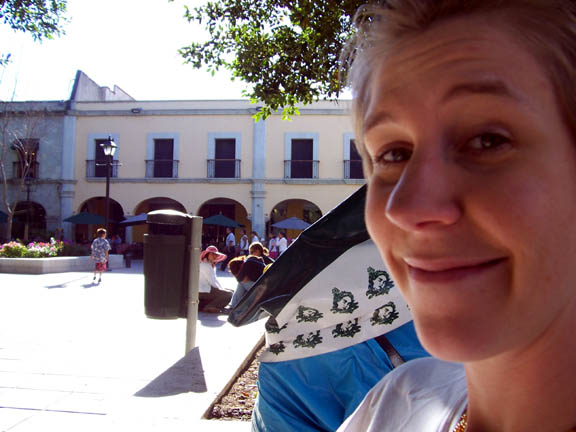
Amy on the zocalo, annoyed that I'm taking her picture before the morning coffee has worked its magic.


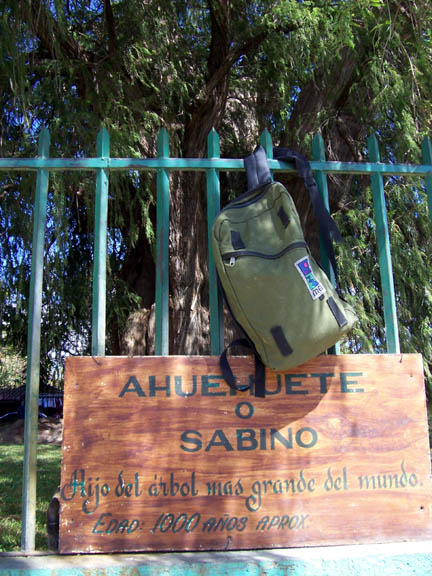
Mike's bag visits Tule's offspring.


The meat aisle in one of Oaxaca's largest markets. In a row of roughly 30 such vendors, we saw one cold case. Americans are so pampered.


The best part of the trip to Tule (aside from photographing our friend Mike's bag at the site) was sitting at a roadside cafe afterward. We drank a couple of beers and watched as at least two generations of women cooked tlayudas and quesadillas. They worked over a hot bed of coals, making everything down to the tortillas as came in from a table two feet behind them. The oldest woman would throw a ball of masa onto a press and squash it two or three times. Then she cooked the tortilla on a flat pan (similar to a round pizza pan) over the coals. Once that was done, she added Oaxacan string cheese and squash flowers.

After watching all that, we had to order one. It was fabulous.

Tlayudas are one of the main dishes of Oaxaca. They are a large (12"-14" in diameter) crispy tortilla topped with smooth black beans, Oaxacan cheese, slices of tomato, avocado and a grilled flank steak.

The woman use a grill basket when they cook the steak. They place the basket directly on the coals so they can keep cooking atop the pan. After assembled, the tlayuda is placed on the top level of the grill to warm. The women have a bowl of water to rinse their hands, but seem to have no worries about bouncing from the raw meat to the finished dishes.

The old woman used no utensils. She flipped the tortillas and the quesadillas by hand. OUCH!
They keep towels over the ingredients to keep bees off them. And there is a knife they share to slice each tomato and avocado. They make the cuts while holding them in the palm of their hand; no cutting boards.

Back in the city, we had squash flower soup at dinner. Very good. And nice to get some greens.